Amazon's Choice Badge: What It Means, How Amazon Awards It, How to Earn It, and How Frequently Bought Together and Best Seller Placements Work
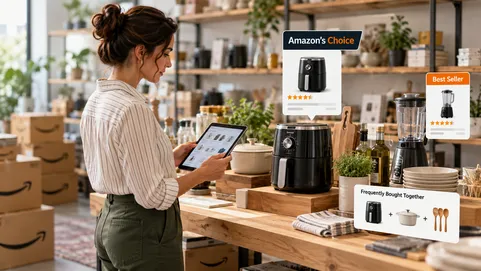
Amazon's Choice is a badge Amazon awards automatically, per search term, to listings its algorithm rates as highly rated, well priced and available to ship immediately. There is no application and no fee, and no seller controls the algorithm directly, only the inputs it scores. This guide covers what the badge means, the inputs that matter, how to earn it, and how Frequently Bought Together and the Best Seller badge work alongside it.
What Amazon's Choice means, for shoppers and for sellers
The badge started in 2015 as a way to make voice orders through Echo devices workable: with no screen to compare on, Amazon needed one recommended product per spoken query. It has since spread to ordinary search, and hovering over it still shows Amazon's own description: highly rated, well-priced products available to ship immediately.
For a shopper, the badge signals a product Amazon's system considers a strong match for their search. For a seller, it is a visibility boost on that specific search term. The badge is awarded per keyword, not to the whole listing permanently, so a product can hold it for "hair clippers" and not for "hair cutters", even though a shopper would mean the same thing by either.
It differs from the Best Seller badge, which reflects sales rank within a category rather than a match to a specific search term.
How Amazon awards the badge: the inputs
Amazon does not publish weightings, and this post does not invent them. The inputs it is known to weigh:
Input | What Amazon looks at |
| Rating and review count | Most reviews in the 4 and 5-star range, with enough of them to be meaningful |
| Price | Competitive relative to similar listings; Amazon defines no exact threshold |
| Prime eligibility and stock | In stock and able to ship immediately; Prime is the simplest way to meet the "ship immediately" wording |
| Returns rate | Lower than similar products |
| Keyword relevance | How closely the listing matches the specific search term the badge appears against |
| Sales velocity | Sales for that search term relative to competing listings |
How to earn Amazon's Choice
Work each input directly rather than chasing the badge as a single goal.
Build a review flow so rating and count both climb, using Amazon's Request a Review feature and the other approved routes; how to get reviews on Amazon covers them.
Price competitively relative to comparable listings. Prices move constantly, so a repricer with sensible rules does this better than setting a price once and leaving it.
Stay Prime-eligible and keep stock available consistently. An occasional stockout can cost the badge on a term it previously held.
Improve listing relevance to the specific terms you want to win. Keyword research matters more for this badge than most, because it is awarded per term; Amazon SEO covers this in depth.
Keep returns and defects down. Amazon performance metrics covers the account-health side of the same signal.
Frequently Bought Together: how it works and how to influence it
Frequently Bought Together shows shoppers items Amazon's algorithm has learned tend to sell alongside what they are viewing. A shopper looking at a tent sees a sleeping bag, a sleeping pad or a tarp, and can add all of them or just the ones they want. The placement is generated from actual co-purchase behaviour across the catalogue; there is nothing a seller submits or requests.
What influences it: promotions that pair a target product with related items at a discount when bought together, with the "Add both to cart" option enabled. Buyers respond to the offer, and if the pairing holds, the algorithm learns a real association over time. Bundling related items you already carry works the same way, and bundles are also a way to move slow sellers before they attract long-term storage fees. Once a bundle has run for a while, offer the same items separately: if they keep selling together at similar rates without the discount, the association is real and the placement tends to follow.
What does not reliably work, and is not recommended: coordinating with another seller to manufacture an artificial co-purchase pattern through affiliate commissions or reciprocal coupon codes. Amazon's algorithm is built to discount manufactured signals, and engineering them sits closer to manipulation than marketing.
The Best Seller badge and other placements
Best Seller reflects sales rank within a specific category, recalculated frequently, and is a function of sales volume rather than the multi-input scoring behind Amazon's Choice; Amazon sales rank explains how it is calculated.
New Release highlights recently launched products building sales momentum in their category, useful visibility in the early weeks after launch. Overall Pick and similar labels work like Amazon's Choice, an algorithmic signal based on the same broad inputs of rating, price and availability, applied more broadly than to one search term.
Packaging and the inputs it affects
Amazon's FBA packaging and prep requirements cover box and poly-bag standards, weight and dimension limits per shipment type, barcode and labelling rules so items scan correctly at the fulfilment centre, and specific prep for fragile, liquid or hazardous items. The current rules are in Seller Central's packaging and prep requirements pages and change often enough that they are worth re-reading before each new shipment type.
Beyond compliance, packaging affects the badge's inputs indirectly. Packaging protects, identifies and promotes the product, and an item that arrives damaged because of inadequate packaging drives returns and negative reviews, both of which work against the rating and returns-rate inputs. Branded, well-protected packaging is a returns-and-reviews lever more than a badge-earning tactic in its own right.
Protecting the badge once you have it
The badge is not permanent. A rating that slips, a returns rate that climbs or a stockout can all cost it on a term you previously held, since Amazon re-evaluates continuously rather than awarding it once.
Treating new reviews and returns as tickets with the order attached, rather than a separate periodic check, catches a slipping pattern before it costs the badge rather than after. Amazon feedback software handles the review requests and negative-review alerts; a negative review caught and answered quickly, and the 24-hour response rule held consistently, protect the same inputs the badge is scored on. See Amazon helpdesk software for how eDesk connects to Amazon.
FAQ
What does Amazon's Choice mean?
A badge Amazon's algorithm awards automatically, per search term, to listings it rates as highly rated, well priced and available to ship immediately.
How do you get the Amazon's Choice badge?
Improve the inputs Amazon scores: reviews and rating, competitive pricing, Prime eligibility and consistent stock, keyword relevance, and a low returns rate. There is no application or fee, and no seller controls the algorithm directly.
Is Amazon's Choice better than Best Seller?
They measure different things. Amazon's Choice reflects a multi-input quality and relevance score for a specific search term; Best Seller reflects sales rank within a category. Neither is strictly better; they signal different things to a shopper.
How does Frequently Bought Together work on Amazon?
It is generated from actual co-purchase behaviour across the catalogue. Promotions and bundles that drive real co-purchases can help the algorithm learn an association over time; there is no way to submit or request the placement directly.
Can you lose the Amazon's Choice badge?
Yes. It is re-evaluated continuously, not awarded permanently, so a slipping rating, a rising returns rate or a stockout can all cost it on a term you previously held. A tool like eDesk can help catch a slipping review or returns pattern before it affects the badge.
Ready to catch a slipping rating or returns pattern before it costs you a placement?
Author:
