Using ChatGPT for eCommerce Customer Service
)
No matter what industry you’re in today, it’s clear that ChatGPT for eCommerce is having major implications for how you do business, and the eCommerce space is leading the transformation. In fact, you may be reading this blog with one pressing question on your mind: “Will ChatGPT replace humans in customer service?”
The answer has evolved significantly since 2025. While ChatGPT for customer support won’t completely replace humans, it has become an indispensable tool that dramatically enhances what human agents can accomplish. The landscape has shifted from asking whether AI will replace humans to understanding how to use ChatGPT for eCommerce effectively alongside your support team.
According to the latest industry data, 95% of customer interactions are now AI-powered in 2025, with businesses seeing an average return of $3.50 for every $1 invested in AI customer service. This represents a fundamental shift in how eCommerce businesses approach customer service.
What is ChatGPT?
ChatGPT has evolved far beyond its original 2021 training data limitations. Today’s ChatGPT for eCommerce represents a sophisticated ecosystem of AI models that can access real-time information, integrate with business systems, and provide contextually relevant responses based on your specific business data.
Think of it as your most knowledgeable customer service representative who never sleeps, never gets overwhelmed, and has instant access to every piece of information about your customers, products, and business processes. The current generation can understand nuanced conversations, maintain context across multiple interactions, and even detect emotional undertones in customer communications.
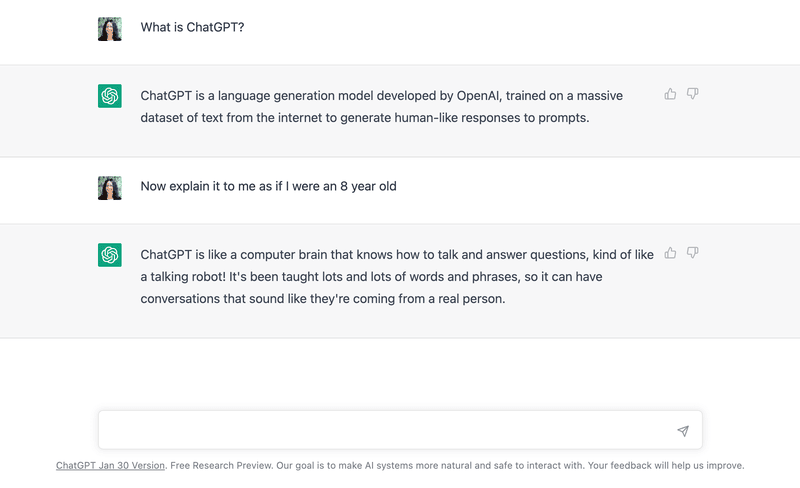
ChatCPT User Interface
Modern ChatGPT for eCommerce systems can now:
Access and process real-time inventory data
Integrate with your CRM and order management systems
Understand complex product specifications and compatibility issues
Process refunds and exchanges automatically
Escalate complex issues to human agents with full context
Learn from each interaction to improve future responses
The Current State of AI in eCommerce Customer Service
The transformation has been remarkable. Early adopters are already reaping significant rewards, with eCommerce businesses reporting 10-12% higher revenue by leveraging AI into their operations. Using ChatGPT for eCommerce has moved beyond basic chatbot functionality to become a comprehensive customer support ecosystem.
Recent statistics reveal the scope of this transformation:
80% of customer service organizations now use generative AI to enhance agent productivity
69% of consumers prefer AI-powered self-service tools for quick issue resolution
75% of customer inquiries can be resolved by AI tools without human intervention
Companies report an 87% reduction in average customer service resolution times
But the most compelling development is how ChatGPT for eCommerce has overcome its earlier limitations through advanced integration capabilities and training on business-specific data.
Beyond the Original Limitations: 2025 Capabilities
The ChatGPT limitations outlined in earlier years have largely been addressed through sophisticated integration strategies and advanced AI architectures. While the original concerns were valid, today’s ChatGPT for customer support systems operate quite differently:
Real-Time Data Access
Modern ChatGPT for eCommerce implementations don’t rely solely on pre-trained data. They integrate with your business systems to access:
Current inventory levels and product availability
Real-time order status and shipping information
Customer purchase history and preferences
Current pricing and promotional information
Return and exchange policies specific to each situation
Business Context Understanding
Today’s systems are trained on your specific business data, including:
Your complete product catalog with specifications and compatibility
Historical customer service interactions and resolutions
Your brand voice and communication style
Industry-specific terminology and processes
Seasonal patterns and common customer behaviors
Advanced Problem-Solving Capabilities
ChatGPT for eCommerce now handles complex scenarios like:
Processing partial refunds based on specific circumstances
Coordinating replacements for defective products
Managing subscription modifications and billing adjustments
Handling warranty claims with automatic validation
Resolving shipping issues with carrier integration
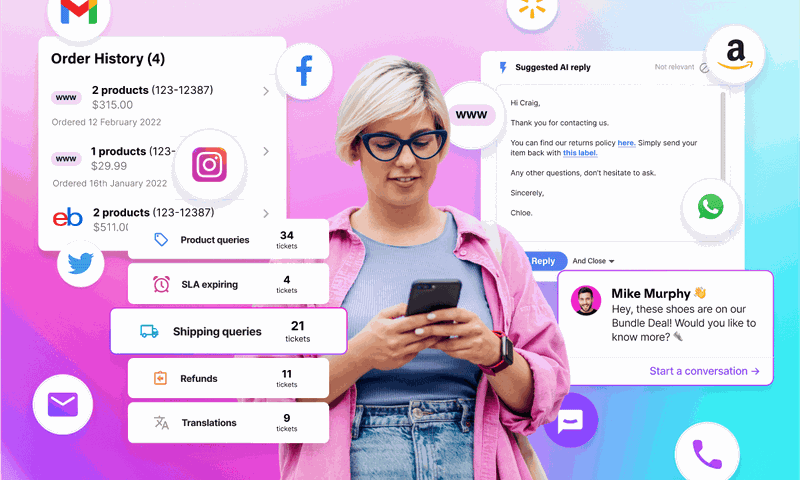
AI powered customer service in eCommerce is already here!
When comparing ChatGPT for eCommerce versus traditional customer support approaches in 2025, the advantages are substantial. However, the key is understanding that it’s not about replacement but enhancement.
Modern eCommerce customer service platforms like eDesk now integrate advanced AI capabilities that include:
Intelligent Response Suggestions: AI analyzes customer queries alongside order history, product data, and previous interactions to suggest personalized responses
Automated Information Integration: Customer details, order status, shipping information, and product specifications are automatically inserted into responses
Smart Ticket Management: AI automatically categorizes, prioritizes, and routes tickets to the most appropriate agents
Predictive Issue Detection: Systems identify potential problems before customers report them
Multilingual Support: ChatGPT for customer support now provides native-level support in over 59 languages
Sentiment Analysis: AI detects customer frustration levels and escalates accordingly
Proactive Engagement: Systems initiate contact based on customer behavior patterns
The difference is profound. Where traditional systems required agents to manually gather information and craft responses, ChatGPT for eCommerce provides instant access to comprehensive customer insights and suggested solutions.
Advanced Integration Capabilities in 2025
Using ChatGPT for eCommerce effectively means leveraging its integration capabilities with your entire tech stack:
eCommerce Platform Integration
Modern AI systems connect directly with platforms like Shopify, BigCommerce, and WordPress, providing:
Real-time inventory updates and product recommendations
Automatic order processing and modification capabilities
Integrated shipping and tracking information
Dynamic pricing and promotional code application
CRM and Customer Data Integration
ChatGPT for customer support now seamlessly integrates with customer relationship management systems to provide:
Complete customer journey mapping
Purchase prediction and personalized recommendations
Automated follow-up sequences based on customer behavior
Real-time chat capabilities with full customer context
Business Intelligence and Analytics
Advanced AI systems provide comprehensive insights including:
Customer satisfaction trends and predictive analytics
Agent performance optimization recommendations
Product issue identification and resolution tracking
Revenue impact analysis of customer service improvements
The Human Element: Where AI Enhances Rather Than Replaces
The most successful ChatGPT for eCommerce implementations in 2025 recognize that human connection remains irreplaceable for complex emotional situations and creative problem-solving.
AI Handles Routine Excellence
ChatGPT for customer support excels at:
Instant responses to common questions about shipping, returns, and product information
Processing standard transactions like exchanges and refunds
Providing 24/7 availability across all time zones
Handling multiple conversations simultaneously without quality degradation
Maintaining consistent brand voice and policy adherence
Humans Deliver Exceptional Moments
Human agents focus on:
Complex problem-solving requiring creative solutions
Emotional support during difficult situations (like the balloon example for chemotherapy celebration)
Building relationships and brand loyalty through personal connection
Making judgment calls that go beyond standard policies
Handling escalated situations with empathy and understanding
The Hybrid Advantage
The most effective approach combines both, with AI handling up to 70% of routine inquiries while seamlessly escalating complex issues to human agents with full context and suggested solutions.
Implementing ChatGPT for eCommerce: 2025 Best Practices
Start with Strategic Planning
Successful ChatGPT for eCommerce implementations begin with clear objectives:
Identify your most common customer service inquiries
Map customer journey touchpoints where AI can add value
Define escalation triggers for human intervention
Establish performance metrics and success criteria
Choose Integrated Solutions
Rather than building custom systems, leverage platforms that offer comprehensive integration:
Customer Service Platforms: Tools like eDesk that include built-in AI capabilities
eCommerce Integrations: Solutions that connect directly with your online store
CRM Integration: Systems that access your complete customer database
Analytics Integration: Platforms that measure AI performance and customer satisfaction
Focus on Training and Customization
Using ChatGPT for eCommerce effectively requires:
Training AI systems on your specific product catalog and policies
Customizing responses to match your brand voice and values
Regular updates based on customer feedback and new scenarios
Continuous optimization based on performance metrics
Maintain Human Oversight
Implement robust quality control measures:
Regular review of AI-generated responses
Customer feedback integration for continuous improvement
Clear escalation paths for complex situations
Ongoing training for human agents on AI-assisted workflows
Measuring Success: 2025 KPIs for ChatGPT in eCommerce
Track these critical metrics to optimize your ChatGPT for customer support implementation:
Operational Efficiency Metrics
First Response Time: Target under 1 minute for AI responses
Resolution Rate: Aim for 70% of inquiries resolved without human intervention
Customer Satisfaction Scores: Monitor CSAT, NPS, and customer effort scores
Agent Productivity: Measure increased case resolution per agent
Business Impact Metrics
Cost Per Case: Track reduction in customer service costs
Revenue Impact: Monitor upselling and cross-selling through AI interactions
Customer Retention: Measure impact on repeat purchases and loyalty
Conversion Rate: Track improvement in inquiry-to-purchase conversion
The Future of ChatGPT in eCommerce Customer Service
Looking ahead, ChatGPT for eCommerce will continue evolving with:
Enhanced Personalization
AI systems will provide increasingly sophisticated personalization by:
Predicting customer needs before they’re expressed
Offering proactive solutions based on purchase patterns
Personalizing communication style to individual preferences
Integrating with IoT devices for proactive customer support
Advanced Problem Resolution
Future capabilities include:
Automated resolution of complex multi-step processes
Integration with augmented reality for visual product support
Voice-based live support with natural conversation capabilities
Predictive maintenance alerts for purchased products
Broader Business Integration
ChatGPT for eCommerce will expand beyond customer service to include:
Sales assistance and product consultation
Marketing automation and lead nurturing
Inventory management and demand forecasting
Supply chain optimization and vendor communication
Getting Started: Your 2025 Action Plan
If you haven’t yet implemented ChatGPT for eCommerce, here’s your roadmap:
Phase 1: Assessment and Planning (Month 1)
Audit your current customer service processes and pain points
Identify high-volume, routine inquiries suitable for AI automation
Research integrated solutions that match your eCommerce platform
Set clear objectives and success metrics
Phase 2: Implementation and Training (Months 2-3)
Deploy AI-powered customer support tools with your existing systems
Train AI systems on your product catalog, policies, and brand voice
Establish escalation protocols and human agent workflows
Begin with a limited rollout to test performance
Phase 3: Optimization and Scaling (Months 4-6)
Analyze performance data and customer feedback
Refine AI responses and expand automation capabilities
Scale successful implementations across all customer service channels
Train staff on AI-assisted workflows and advanced features
Final Thoughts
Using ChatGPT for eCommerce customer service in 2025 isn’t about replacing human connection but amplifying it. The technology has evolved from a promising experiment to a business-critical tool that enables exceptional customer support at scale. Whilst we have our brand guidelines, tone of voice, and procedures to follow, it’s okay to just be a compassionate human being.
The businesses thriving today are those that have embraced ChatGPT for customer support as a strategic advantage, using it to handle routine excellence while freeing their human teams to deliver the empathy, creativity, and personal connection that builds lasting customer relationships.
Want to learn more about how eDesk can integrate advanced AI capabilities into your customer service strategy? The future of eCommerce customer support is here, and it’s powered by the intelligent combination of AI efficiency and human empathy.
The acceleration of AI improvements will inevitably lead to even more prominence of this technology in the eCommerce customer service space, but successful businesses will always keep customers’ needs at the forefront of any changes. AI should drive efficiencies that improve both customer and agent experiences, but when your customers “just want to speak to a real person,” make sure you’ve got an amazing team of support people ready across all the channels your customers use.
Book a free demo today to learn more about how eDesk can help you make the most of ChatGPT’s eCommerce customer service opportunities.