Amazon Multi-Channel Fulfillment (MCF) Explained: Fees, Eligibility, How It Works for eBay and Shopify Orders, and When to Use Your Own Warehouse Instead
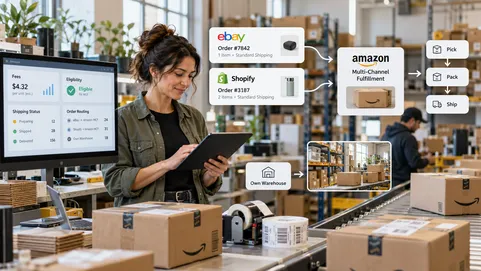
Last verified September 2026. Fee figures checked on this date; MCF fees change at least annually, so re-check before republishing. Amazon Multi-Channel Fulfillment (MCF) lets Amazon ship orders that came from a different sales channel, eBay, Shopify, Walmart, TikTok Shop or your own site, out of the same FBA inventory you already store with Amazon. It is for sellers who already hold FBA stock and want one fulfilment operation instead of several. The two questions sellers actually ask: what does it cost, and does my channel support it. This guide covers both, plus eligibility, per-channel setup, MCF versus a 3PL or your own warehouse, and what MCF does to customer service.
What multi-channel fulfillment is and how Amazon's version works
Multi-channel fulfilment, as a general term, means using one inventory pool and one fulfilment operation to serve several sales channels rather than running separate stock and shipping for each. Amazon's version, MCF, runs on top of inventory held in Amazon's fulfilment centres: Amazon picks, packs and ships the order regardless of which channel it came from. You do not have to sell on Amazon to use it, but most sellers who do are already running FBA and simply extend that stock to their other channels.
The order can reach Amazon three ways. Entered manually in Seller Central: open Manage FBA Inventory, select the products, choose Create Fulfillment Order, enter the buyer's details and the channel's order reference, add an optional note for the packing slip, and Amazon shows a price estimate before you submit; several orders can be uploaded together as a flat file. Synced automatically through an official channel integration (Shopify, eBay and others each have one). Or pushed through Amazon's MCF API for a seller running their own systems or a connected helpdesk. Tracking flows back the same way, which matters, since the receiving channel needs that tracking number to consider the order fulfilled on time.
MCF fees in 2026
MCF pricing runs by size tier and shipping speed, with three standard speed options: standard (around 3 business days), expedited (2 days) and priority (1 day). Fees increased across most standard-size categories on 15 January 2026, and a 3.5% fuel and logistics surcharge applies on top of the base fulfilment fee from 2 May 2026.
Size tier and speed | Base fee per unit | Notes |
| Small standard, Standard (3 days) | [INSERT FROM RATE CARD] | Plus 3.5% fuel and logistics surcharge |
| Small standard, Expedited (2 days) | [INSERT FROM RATE CARD] | Plus 3.5% surcharge |
| Small standard, Priority (1 day) | [INSERT FROM RATE CARD] | Plus 3.5% surcharge |
| Large standard and oversize tiers | [INSERT FROM RATE CARD] | Rates rise by tier |
| Multi-unit orders (3 or more units) | Discounted per unit | Up to 50% off the per-unit fee at higher counts; the January 2026 increase did not apply to orders of 3 or more units |
| Holiday peak (15 October to 14 January) | +0.35to+1.00 per unit | By size tier, small standard to extra-large, on top of the base rate |
Two discount programmes are worth knowing. SIPP (Ships in Product Packaging) discounts the fulfilment fee for ASINs enrolled to ship in their original manufacturer packaging rather than an Amazon box. MCF Preferred Pricing offers up to 15% off fees for eligible sellers, capped at 100,000 MCF units or 12 months from enrolment, whichever comes first, after which standard rates resume.
Eligibility, restrictions and the rules that trip sellers up
Most products eligible for FBA are also eligible for MCF, with restrictions on certain regulated or hazardous categories; check current restricted-product rules before committing inventory.
Packaging: MCF ships in unbranded packaging by default for off-Amazon channels, precisely so a buyer on eBay or Shopify does not receive a box branded as if it came from Amazon.com directly.
Carrier rules vary by channel. Walmart in particular restricts orders shipped under certain Amazon-logistics carrier labels on Walmart Marketplace orders; sellers running MCF into Walmart need to confirm current carrier settings support Walmart's own delivery requirements rather than assuming any MCF shipment qualifies.
Delivery-speed promises matter too: whatever speed a channel's checkout promised the buyer needs to match what MCF can actually deliver for that product and destination. A mismatch here shows up as a channel-side late-delivery complaint even though Amazon fulfilled the order correctly.
MCF for eBay orders
Running eBay orders through MCF means the order syncs, or is entered manually, into Amazon's system, which then fulfils it from FBA stock and pushes tracking back so the eBay order shows as shipped and on time.
Two mistakes account for most of the problems sellers report: tracking not making it back to eBay in time, which reads to eBay's system as a late or unfulfilled order even though the item shipped, and an Amazon-branded box arriving at an eBay buyer's door, which can prompt the buyer to check whether the same item is cheaper on Amazon directly. The unbranded-packaging default addresses the second; a tested, working tracking sync addresses the first. Our eBay helpdesk software page covers running eBay support beside Amazon.
MCF for Shopify, Walmart and TikTok Shop
Shopify: Amazon publishes an official Multi-Channel Fulfillment app in the Shopify App Store that syncs orders and inventory automatically once connected, removing the need for manual entry. Our Shopify helpdesk app page covers the support side.
Walmart: MCF can fulfil Walmart Marketplace orders, but Walmart's own carrier and delivery requirements need checking against current MCF carrier settings; this is the channel most likely to reject a shipment method that works fine elsewhere.
TikTok Shop: MCF's native integration handles order sync for TikTok Shop sellers, which matters in particular for demand spikes; a viral product moment does not require standing up separate fulfilment infrastructure if the inventory is already in FBA.
MCF versus a 3PL versus your own warehouse
MCF centralises everything into one inventory pool and one fulfilment relationship: no separate contracts, no separate stock to reconcile, one call when something needs changing, and the same quality control on every channel. The trade-off is packaging control, since MCF ships unbranded by default, so a seller who wants a fully branded unboxing experience loses that lever, and dependence on a single provider for every channel.
Cost tends to favour MCF for smaller, lighter, standard-size items moving at moderate volume, especially when the seller has no negotiated carrier rates of their own. It tends to favour a 3PL or an owned warehouse once volume is high enough (roughly several thousand orders a month) that negotiated carrier rates start beating MCF's per-unit pricing, and for heavy or bulky items, where MCF's per-pound charges climb quickly.
Rule of thumb: if you are already running FBA and your off-Amazon channels move standard-size, moderate-volume orders, start with MCF and revisit a 3PL only once volume or product weight makes the maths close. If you are not running FBA at all, or you sell mostly heavy or oversized items, price a 3PL alongside MCF before committing either way.
What MCF does to customer service
This is the part the fee guides and 3PL comparisons do not cover. The order is fulfilled by Amazon, but the buyer belongs to whichever channel they bought from, and every support touchpoint has to happen there, not on Amazon.
A "where is my order" question from an eBay or Shopify buyer lands in that channel's messaging system, not Amazon's, even though Amazon is the one that shipped it. The tracking number originates from Amazon and has to be visible and current on the channel side; a sync failure here is invisible to the seller until a buyer complains.
A return on an MCF order runs through whichever channel the buyer bought from, not through Amazon's own return flow, with the unit going back into FBA stock or elsewhere depending on how return routing is configured; our guide to Amazon returns for sellers covers the Amazon side. Lost or damaged MCF inventory is claimed through Amazon's FBA reimbursement process, a distinct process from the Amazon A-to-z claims a buyer can file.
What a support team needs visible on every MCF-related ticket, regardless of which channel it came in on: the channel's own order reference, the Amazon MCF order ID, current tracking, and the return status if one is in progress. Without all four in one place, a WISMO ticket on an eBay order fulfilled by Amazon means checking two systems just to answer one question.
Setting up MCF: a checklist
Check eligibility for the specific products you want to run through MCF against current restricted-category rules.
Set packaging (unbranded is the default; SIPP if the product qualifies and you want the discount) and confirm carrier settings work for every channel you plan to fulfil, Walmart especially.
Connect the channel integration: the official app where one exists, or the MCF API through a connected system.
Run a tracking-sync test on one real order per channel before turning it on for everything; confirm the tracking number actually posts back and the order shows as shipped correctly.
Confirm the fee model for that channel's typical order profile (size, weight, unit count) against the current rate card.
Set up the support process from the previous section before volume ramps up, not after the first WISMO ticket arrives with no visible tracking.
Running MCF orders in the support inbox
With eBay, Shopify, Walmart and Amazon tickets sitting in one queue, an agent sees the same information regardless of which channel the buyer used: the order, the Amazon MCF order ID, live tracking, and return status, all on the ticket rather than split across systems. A return can be started directly from the ticket, following whichever channel's return process actually applies, without the agent needing to remember which rules go with which platform. Our Amazon helpdesk software page has the full setup across marketplaces.
Frequently asked questions
What is Amazon Multi-Channel Fulfillment?
A service that lets Amazon fulfil orders from other sales channels, eBay, Shopify, Walmart, TikTok Shop, or your own site, out of your existing FBA inventory.
How much does Amazon MCF cost?
Fees run by size tier and shipping speed, with a 3.5% fuel and logistics surcharge on top and discounts available for multi-unit orders and enrolled Preferred Pricing sellers. Check Amazon's current rate card for exact figures, since fees changed in January 2026 and update periodically.
Can I use FBA to fulfil eBay orders?
Yes, through MCF. Tracking needs to sync back to eBay promptly so the order registers as shipped on time, and shipments default to unbranded packaging to avoid confusing eBay buyers.
Does Walmart allow Amazon MCF?
Yes, but Walmart's carrier and delivery requirements need checking against current MCF settings; this is the channel most likely to reject a shipment method that works fine on other channels.
Is Amazon MCF cheaper than a 3PL?
It depends on volume, weight and whether you already have negotiated carrier rates. MCF tends to win for smaller, lighter items at moderate volume; a 3PL tends to win at higher volume or for heavy items. A tool like eDesk keeps every channel's MCF tickets in one queue regardless of which option you land on.
Ready to handle every MCF ticket from one screen?
Handle every MCF ticket, whichever channel it came from, from one screen. Start for free or book a demo.
Author:
