Best Helpdesk Software for Shopify Plus
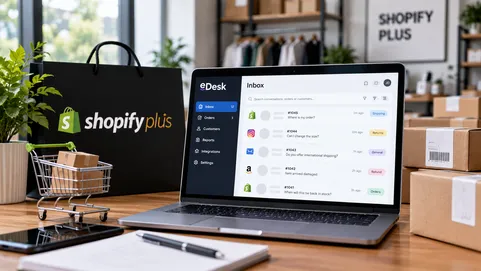
Choosing the best helpdesk software for Shopify Plus comes down to one wall every multichannel brand hits sooner or later: the same customer sends the same message on three channels, three different agents answer it, and nobody sees the full thread. At that point the helpdesk stops being a software preference. It becomes infrastructure, the same category as a payment processor or a shipping tool, because it holds the order history and the customer record every other system depends on.
This guide compares six helpdesks on what matters at Plus volume: native versus bolt-on multichannel setup, order actions from the ticket, marketplace breadth, and how each vendor's AI claims hold up under a closer look. Each is judged on capability and pricing model, not on ratings or a single winner.
TL;DR
The right pick depends on your operating model, not a single winner. Running Shopify Plus alongside marketplaces, eDesk is built for that breadth. Shopify Plus as a DTC-only operation that needs deep order actions from the ticket, Gorgias is the Shopify-first incumbent. Chat-led DTC where live chat is the primary channel, Re:amaze. Self-service-first, where a customer portal deflects tickets before they're opened, Richpanel. Luxury and lifetime-value-led brands prioritising relationship continuity over ticket speed, Gladly. Large enterprises with dedicated technical teams already standardised on one platform, Zendesk.
Why the Helpdesk Is Infrastructure at Plus Scale, Not a Feature Choice
Switching helpdesks costs more at Plus volume than it would for a smaller store. The cost stacks up with everything else that lives in that inbox: order history, customer identity across channels, and the record of how your team has handled thousands of past tickets. Lose that record and new agents start from zero on every call, even the ones a customer has asked before. Pulling the tool out mid-peak, when ticket volume is already high, is a different kind of mistake than trying a new app on a quiet month, where a rough edge costs little.
Channel breadth makes the choice harder, not easier. A Plus brand on Shopify, Amazon, eBay and Walmart needs a tool built to hold four different data formats and four different response clocks at once, not one that added marketplaces as an afterthought. Peak load is the real test. A tool that works fine on a normal week can fall over right when BFCM traffic pushes ticket counts up fast, which is the worst possible moment to find out.
None of this is about picking the feature set with the longest list. It is about picking the setup that will not need replacing the next time order volume doubles.
Native vs Bolt-On Multichannel
A customer messages you on Amazon in the morning about a delayed order. Nobody replies, so they follow up on Shopify chat at lunch. Still nothing, so they DM your Instagram in the afternoon, now annoyed that no one seems to be reading anything. It is the same person with the same problem on three channels, answered by three agents, and each agent sees only their own slice of the story.
That failure traces back to one choice: native multichannel or bolt-on multichannel.
Native multichannel connects straight to each marketplace and channel through its own API. Order data lands on the ticket in real time. The buyer is treated as one person across every channel they have used, not three separate strangers. Replies go back out through the channel they came in on, with nothing in between to break.
Bolt-on multichannel usually starts as a tool that is strong at email and chat, with marketplaces bolted on later through third-party connector apps. Order data arrives late, in pieces, or not at all. Customer identity rarely lines up across channels, since each connector handles it its own way. Reply sync depends on that connector staying online, not on the helpdesk itself.
The gap shows up hardest at peak. That is exactly when the connectors in a bolt-on stack carry the most load and have the least room left to fix a broken sync fast. For most Plus brands, the point where bolt-on stops being good enough lands around the third or fourth channel they add.
Native multichannel | Bolt-on multichannel | |
| Order data on the ticket | Attached in real time | Delayed, partial, or missing |
| Customer identity | One person across channels | Often fragmented per channel |
| Reply sync | Direct, no middleware | Depends on connector uptime |
| Where it breaks | Rarely, even at peak | At peak, when connectors are most loaded |
If you're running several Shopify stores or channels and want the operational detail on running one shared queue across them, see our guide to customer support for multiple Shopify stores.
What Matters at Plus: The Capability Checklist
Six things separate a helpdesk that holds up at Plus volume from one that just lists more features on its pricing page.
Order actions from the ticket. Refunds, cancellations and edits done without leaving the helpdesk for Shopify admin, so an agent never has to open a second tab mid-conversation.
Native marketplace connections, counted from each vendor's own integrations directory on the day of writing, not a vague "multichannel" claim with no number behind it.
Cross-channel customer identity. The same buyer recognised as one person whether they messaged on Shopify, Amazon or Instagram, with their full history visible regardless of which channel they pick up next time.
In-policy resolution, measured by query type. A fair AI claim says what it resolves, such as order-status questions or simple refunds, rather than one headline number across every kind of ticket a store gets.
Per-channel SLA tracking, run on its own and stated the right way. Amazon runs a 24-hour response window as an account-health metric. eBay has no fixed message clock; its Top Rated status is about case and defect rates, not reply speed. Walmart asks for a response inside 48 hours. A helpdesk that tracks each of these separately, instead of applying one target to every channel, is doing the job right.
Reporting tied to outcomes, not just ticket counts, with brand-appropriate tone held the same way on every channel a store sells through.
The Six Helpdesks, With Honest Trade-Offs
eDesk
What it does well: Built around a native multichannel inbox connecting to 300+ marketplaces, web stores and social channels, with Shopify order data (and order actions: refunds, cancellations, edits) attached directly to the ticket rather than looked up separately. Its AI Agent works from live order data and the procedures a merchant sets, across channels.
Where it stops at Plus scale: The breadth that makes it strong for multichannel sellers is more than a single-channel, Shopify-only store needs; entry pricing sits above the cheapest Shopify-only tools.
Pricing model (verified 6 October 2026): Essential, Growth and Professional tiers scale by stores and ticket volume; the Professional plan ($149/month, or $119/month billed annually) covers up to 10 stores or marketplaces, with AI Agent resolutions metered per outcome.
Where it fits: Shopify Plus brands running multiple channels or marketplaces alongside the webstore, where consolidation is the actual problem being solved.
For the Shopify-specific integration, see Shopify customer service apps; eDesk for Shopify covers the Pro plan's multi-store line directly.
Gorgias
What it does well: The Shopify-first incumbent, with some of the deepest native Shopify order actions of any helpdesk on this list: editing, cancelling and refunding orders directly from a ticket, plus a long-established Shopify App Store presence.
Where it stops at Plus scale: Marketplace coverage is thinner than purpose-built multichannel tools; pricing is ticket-based, so cost climbs with volume in a way that gets noticeable at Plus-level ticket counts, particularly around peak.
Pricing model (verified 6 October 2026): Starter $10/month (50 tickets) up to Advanced $900/month (5,000 tickets), Enterprise by custom quote; AI Agent billed separately at roughly $1 per interaction.
Where it fits: Shopify Plus stores that are DTC-only or close to it, where deep native Shopify actions matter more than marketplace breadth.
For a fuller comparison of Gorgias against other Shopify-focused (non-Plus-specific) options, see best helpdesk apps for Shopify.
Zendesk
What it does well: A mature platform with deep customisation, a large app marketplace, and strong reporting through Zendesk Explore. It can handle almost any ticket volume for a team with the technical staff to set it up and keep it tuned over time.
Where it stops at Plus scale: It was not built ecommerce-first, and it shows. Order data does not load onto the ticket on its own; marketplace connections need third-party apps rather than a direct link; and building the Shopify Plus workflows it lacks out of the box takes a lot longer than setting up a tool built for this job already.
Pricing model (verified 6 October 2026): Suite Team 55/agent/month (69 billed monthly), Suite Professional 115/agent/month (149 billed monthly), Suite Enterprise by custom quote.
Where it fits: Large enterprises already standardised on Zendesk with a technical team available to build the ecommerce-specific workflows it doesn't offer out of the box.
Gladly
What it does well: Built around lifelong customer conversation threads rather than discrete tickets, which suits brands where the same customer contacts support repeatedly and continuity matters more than ticket throughput. Confirmed Shopify integration pulls order history and lifetime value data into the agent view, with refunds and cancellations handled from within Gladly.
Where it stops at Plus scale: No confirmed marketplace integrations (Amazon, eBay) at the time of writing; built for relationship depth, not high-velocity multichannel triage.
Pricing model (verified 6 October 2026, via its Shopify App Store listing): A free tier (100 AI interactions, one seat), then a pay-as-you-go Starter Cap at $250/month: $1.50 per AI resolution, $0.25 per AI assist, plus $120/month per team member.
Where it fits: High-end lifestyle and luxury Shopify Plus brands where customer lifetime value and relationship continuity matter more than rapid ticket turnover.
Re:amaze
What it does well: A clean, Shopify-friendly screen with chat triggers that fire based on what a shopper is browsing, plus fast setup. It is strong, in particular, for chat-led support on the webstore itself.
Where it stops at Plus scale: Marketplace reach is thin. It handles webstore chat well, but gaps open up once ticket volume spreads across several channels at once rather than sitting mostly on the storefront.
Pricing model (verified 6 October 2026): A flat Starter at $59/month (500 conversations), then per-agent tiers from Basic at 29/agent/month (26.10 billed annually) up to Plus at 69/agent/month (62.10 annually).
Where it fits: Shopify-first DTC brands where chat is the primary support channel and marketplace volume is light.
Richpanel
What it does well: A well-built self-service portal, in the style of Amazon's own returns flow, for handling returns and order changes without a ticket at all. A good share of routine queries get solved there before an agent ever sees them.
Where it stops at Plus scale: The cross-channel inbox model that a true multichannel seller needs is not where this tool is strongest. The portal is the real strength here, not breadth across marketplaces.
Pricing model (verified 6 October 2026): Seat-based at $99/month billed annually ($119 billed monthly), plus metered AI resolutions.
Where it fits: Shopify Plus brands prioritising self-service deflection over high-touch multichannel engagement.
Comparison Table
Helpdesk | Shopify order actions | Native marketplaces | Cross-channel identity | AI resolution type | Per-channel SLA tracking | Pricing model |
| eDesk | Yes | 300+ (directory, 6 Oct 2026) | Yes | Suggest, route and resolve | Yes | Tiered by stores/tickets |
| Gorgias | Yes, deep | Via add-on | Limited | Suggest and route | Via add-on | Ticket-tiered |
| Zendesk | Via apps | Via middleware | Limited without configuration | Suggest and route (configurable) | Via apps | Per-agent tiered |
| Gladly | Yes | None confirmed | Yes, within Shopify | Suggest and resolve (per-interaction) | Not marketplace-specific | Per-seat + usage |
| Re:amaze | Yes, native | Limited | Limited | Suggest | Limited | Flat + per-agent tiers |
| Richpanel | Yes, native | Limited | Limited | Resolve (self-service-led) | Limited | Per-seat + usage |
No vendor on this list publishes an independently audited AI resolution rate broken out by query type, which is why that column states resolution type rather than a percentage. Treat any vendor's headline resolution percentage with the same scrutiny.
How We Evaluated
Seven criteria, checked against each vendor's own current pages and pricing on 6 October 2026: Shopify order-action depth (refund, cancel, edit from the ticket); native marketplace connection count from the vendor's own integrations directory; cross-channel customer identity; autonomous resolution claims, assessed by whether the vendor specifies which query types they cover; per-channel SLA tracking against each marketplace's actual requirement; brand-appropriate tone controls per channel; and reporting that connects support activity to revenue or retention rather than ticket counts alone.
Disclosure: eDesk is one of the six helpdesks compared here and is eDesk's own product. The same seven criteria were applied to every vendor, including eDesk, and each entry states where that vendor stops as plainly as what it does well.
How to Choose by Operating Model
Shopify Plus and marketplaces. If Amazon, eBay, Walmart or TikTok Shop sit alongside the webstore, a native multichannel setup stops being a nice-to-have. eDesk is built around exactly this case, with order data and identity held in one place across every channel.
Shopify Plus, DTC-only. If the webstore is the only channel and order actions from the ticket matter most, Gorgias's depth on native Shopify actions is hard to match, and its long track record on the Shopify App Store counts for something too.
Chat-led DTC. If live chat on the storefront is the main channel and marketplace volume is light or not there at all, Re:amaze's chat-first design is built for exactly that.
Self-service-first. If the goal is to stop routine returns and order-change questions from becoming tickets in the first place, Richpanel's portal does that work well.
Luxury and lifetime-value-led. If the same customers come back to support again and again and keeping that relationship warm matters more than ticket speed, Gladly's thread model fits well, with the one caveat that it has no confirmed marketplace reach today.
Enterprise with dedicated technical resources. If the brand is already standardised on Zendesk and has a team on hand to build the ecommerce workflows it does not offer out of the box, that sunk cost and in-house know-how can outweigh switching to a tool built for this job already.
For the operational side of running Shopify Plus support day to day, rather than choosing the tool, see our guide to Shopify Plus customer service. If you're still deciding whether Plus itself is worth the upgrade, see Shopify Plus vs Shopify.
Book a Free Demo to see what one inbox with order actions, native marketplace connections and AI resolution does on your own channels, or go to eDesk for Shopify to look at the product directly.
FAQ
Which helpdesk works best with Shopify Plus? It depends on operating model rather than one universal answer. eDesk fits Plus brands running marketplaces alongside Shopify; Gorgias fits Plus DTC-only stores wanting deep native Shopify actions; Re:amaze fits chat-led DTC; Richpanel fits self-service-first operations; Gladly fits luxury and lifetime-value-led brands; Zendesk fits enterprises already standardised on it.
Does Shopify Plus come with a helpdesk? No. Shopify Plus includes Priority Support, Shopify Plus Academy and tools like Launchpad and Flow for merchants running the platform, but none of that answers your own customers' support tickets. That's a separate tool you choose and run yourself.
What is the difference between native and bolt-on multichannel support? Native multichannel connects directly to each marketplace via its own API, with order data and customer identity synced in real time. Bolt-on multichannel is usually strong at email and chat, with marketplaces added through third-party connectors, which means order data often arrives late or incomplete and customer identity rarely reconciles across channels.
Can one helpdesk cover Shopify Plus, Amazon and eBay? Yes, if it's built on native multichannel architecture rather than bolt-on connectors. eDesk is built for exactly this combination; most other tools on this list are stronger on Shopify specifically than on marketplace breadth.
How do I judge an AI resolution claim? Ask which query types the percentage covers (WISMO, simple refunds, general questions) rather than accepting one headline number across all ticket types. No vendor compared here publishes an independently audited resolution rate broken out this way, which is itself worth asking about.
Do I need a different helpdesk for several Shopify Plus stores? Not necessarily. The requirement is a helpdesk that puts several stores in one queue with per-store policy and tone still enforced separately. See our guide to customer support for multiple Shopify stores for the operational detail.
The architecture question (native versus bolt-on) usually matters more than any single feature on a vendor's page. If you're running Shopify Plus alongside marketplaces and want to see what native multichannel looks like against your own channels, Book a Free Demo, or go to eDesk for Shopify to look at the product directly.
Author:
